Revitalizing the Legacy of Pioneering Female War Photographer Gerda Taro
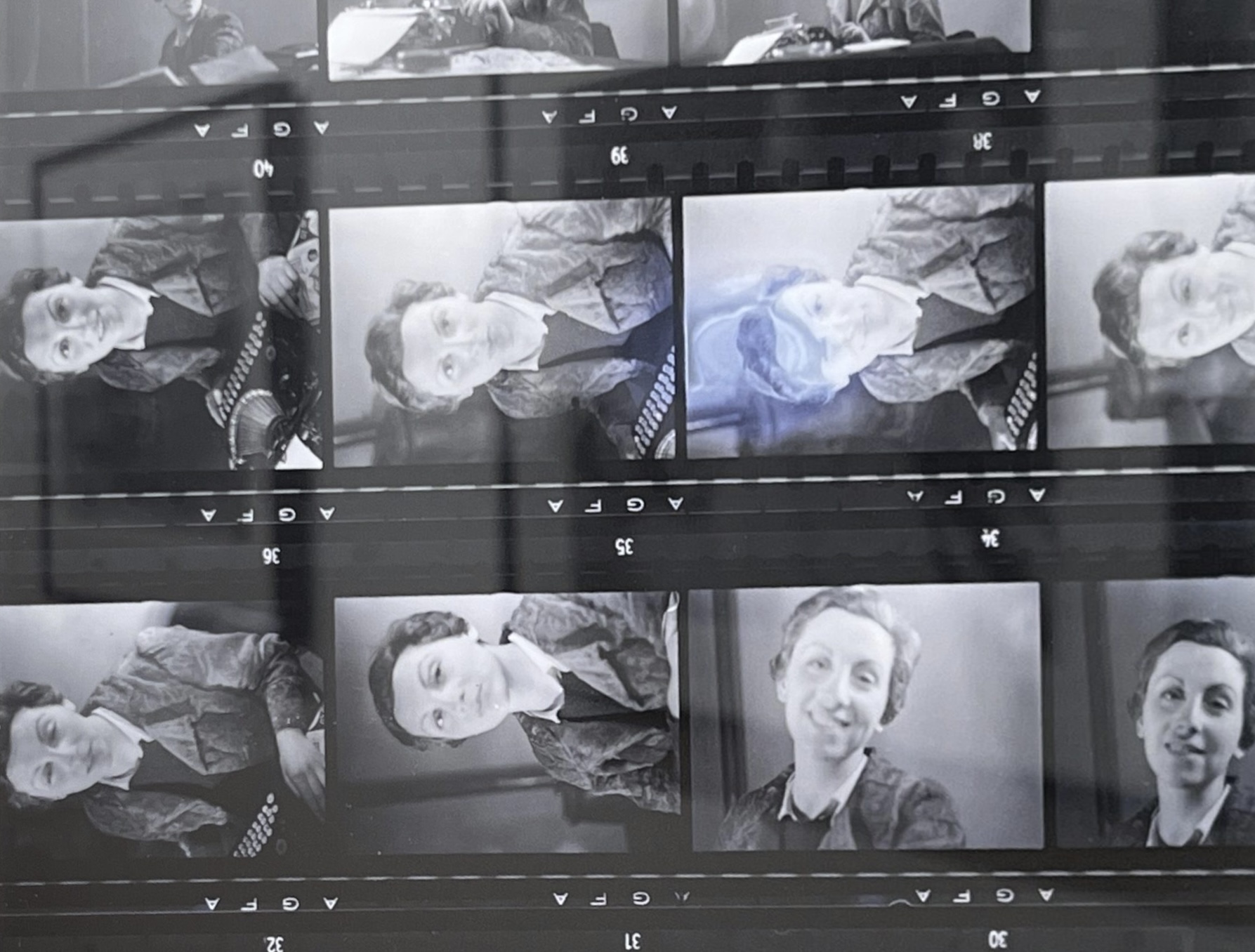
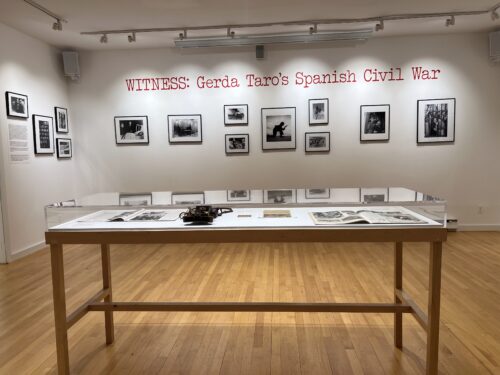
Gerda Taro, one of the first female war photographers, died on the battlefield at 26 years old. Her work is revisited in WITNESS: Gerda Taro and the Spanish Civil War, now on view at The Capa Space in Yorktown Heights through July 20.
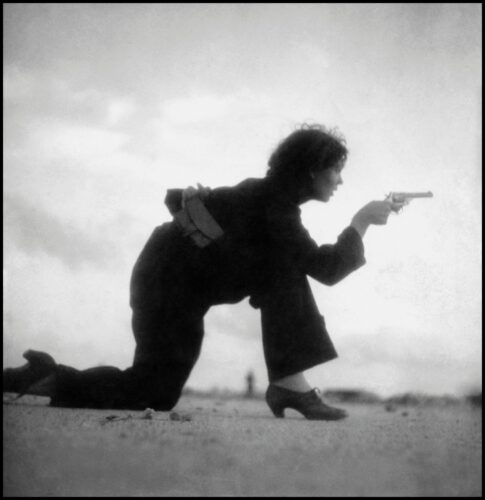
The exhibition features what is arguably Taro’s most famous photograph, taken of a Republican militiawoman training on a beach during the Spanish Civil War. The woman, crouched on one knee, concentrates on aiming a handgun. Her body language mirrors the shape of the weapon in her hand. She is centered in the frame and—sporting heels—is a recognizably feminine figure.
“A lot of people who come though think it’s her,” says Capa Space founder Elise Graham. On the militiawoman’s stature, board member Abigail Lewis adds, “It’s totally unexpected. I think that even today, that’s unexpected, but certainly at that time.”
Photography and Activism: Gerda Taro and Robert Capa
The Capa Space, named after brothers Robert and Cornell Capa, both photojournalists, is located in the former schoolhouse of the Amawalk Friends Quaker Meeting House. After Robert was killed photographing the First Indochina War, Cornell—who became the keeper of Robert’s legacy—chose a Quaker burial for his brother. Robert’s remains were airlifted from Hanoi, Vietnam, and he was buried on site in 1954. Cornell outlived his brother by 50 years; now the two are buried next to one another.
The Capa Space is intended to “foster… the belief that photography [can] advance concepts of peace, equality and justice,” a belief core to Robert and Cornell’s practice as “concerned photographers.” This idea is also central to Taro’s work. “[She] was a political and social activist first,” says Graham.
German-born Taro was born Gerda Pohorylle in 1910 to a Jewish family. In the spring of 1933, she was incarcerated for three weeks because of her ties to anti-Nazi groups. By the fall of that year, she and a friend relocated from Leipzig, Germany to Paris, France. Graham notes Taro’s oeuvre was created despite her being an active communist, being Jewish and being a woman during a hostile time: “None of that stopped her.”
In Paris, Taro acquired technical knowledge of photography through the mentorship of Fred Stein, a Jewish photographer who similarly had fled Nazi Germany. Paris is also where Taro fatefully met Robert Capa, then known as André Friedmann. Like Taro and Stein, Capa moved to Paris to escape antisemitism and political upheaval. Taro and Capa would become lovers and creative partners.
Becoming a Professional Photographer
In a booklet written for WITNESS, curator Marie Keller explains that in the 1930s, photography was popular among many fleeing fascism: “Cameras were…affordable tools and photographs had the potential to reach an international audience.” Photography was an attractive medium to Taro, who needed to find work in Paris and who could use it to tie her vocation to her political beliefs.
Keller describes Taro’s astute business acumen in the exhibition’s booklet: Taro dressed sharply and was instrumental in helping to build the professional persona by which the photographer ‘Robert Capa’ became known. “She was a more than equal partner in [her relationship with Capa],” says Graham, “It was her idea to change their names. She was the hustler.”
The couple moved to Spain after Franco’s invasion in 1936, knowing that photography of the conflict would be in high demand—and while also sympathizing with the loyalist cause.
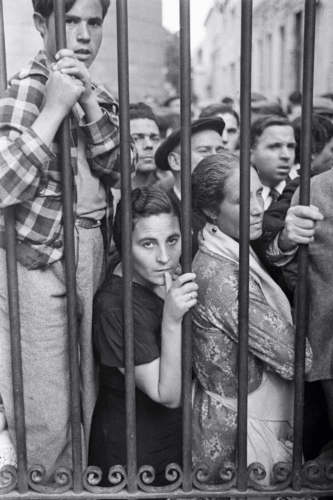
Most of the photos displayed in WITNESS are of Taro’s work in Spain. The photographs depict young boys on barricades, Spanish civilians, agricultural workers and more, with a clear eye for composition and an empathetic lens. Graham suggests that in certain ways Taro’s gender aided her photography: “I think people…saw a woman taking photographs, they were maybe a little less uptight, or on guard…there’s kind of a naturalness to the photographs where…she’s very close to her subject.”
Rediscovering the Work of Gerda Taro
The quality of Taro’s work is notable considering she worked professionally for only a year and a half. On July 26, 1937, she died from injuries inflicted by an out-of-control loyalist tank, having ignored a warning the day prior to avoid the frontlines.
Taro gained notoriety by the time of her death. Her photographs of Spain were widely seen in Paris, and the magazine Ce Soir, one of the publications she worked for, touted her as a communist heroine after her passing. Her story made a cultural impact: WITNESS features a trading card depicting her death distributed by an American chewing gum company, and Alberto Giacometti designed a sculpture of a falcon for her headstone. Tens of thousands followed her funeral procession through the streets of Paris.
After her death, and perhaps due to the short length of her career, Taro faded somewhat into obscurity. In 2007, what is now known as the “Mexican Suitcase” was delivered to Cornell Capa, who at that time had founded the International Center of Photography. The Suitcase contained thousands of negatives taken during the Spanish Civil War by Taro, Robert Capa and another colleague. The package had been entrusted to a darkroom assistant by Robert Capa, and somehow through a Mexican ambassador to the Vichy government, the negatives ended up in Mexico City.
Among the Mexican Suitcase photographs, 800 have been identified as Taro’s. The photos exhibited in WITNESS selected from these images were previously unseen before the 2000s.
Graham hopes that WITNESS and Taro’s story will inspire contemporary audiences to use photography as a means for change: “Take up a camera…see what you can do. [Taro did a lot] in an extremely short amount of time…You too can be bold… You can have political social commitments. You can pick up a camera and go there.” Lewis agrees and encourages exhibition-goers to remain open to the intensity of Taro’s photographs: “Don’t look away.”
Notable Dates
WITNESS: Gerda Taro’s Spanish Civil War is on view through July 20. A special Q&A with curator Marie Keller will be held in the gallery on July 18 as part of Upstate Art Weekend.
A closing reception will take place on July 20.
You May Also Enjoy
- Artist ransome Traces African American Roots in Solo Exhibition — on view at Pelham Art Center
- Ali Banisadr: A History of the World — on view at Katonah Museum of Art
- More Than a Dozen Upcoming Jazz Concerts in Westchester
- 2025 Film Festivals in Westchester
- Schoolhouse Theater: A 40th Season with Jazz, Scandal and Mishaps
- Westchester Ballet Company: Turning 75 With Plans of the Future
- Adam Levi: Sculpting the Way Art is Viewed in Rye
- Caramoor’s 80th Season is for Dabblers and Devotees Alike
For more arts news and updates, visit artsw.org/artsnews.
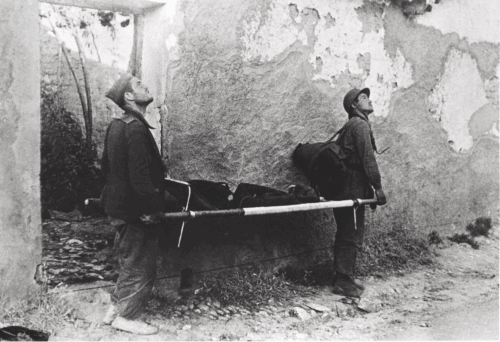
Photos (top to bottom): On view at The Capa Space (photo credit: Dan Wood); Woman training for a Republican militia by Gerda Taro (1936) (photo by Gerda Taro, courtesy of International Center of Photography); Republican Stretcher Bearers (1937), photo by Gerda Taro, courtesy of International Center of Photography; WITNESS exhibition on view at The Capa Space (photo credit: Dan Wood); Crowd at the Gate of the Morgue (1937) (photo by Gerda Taro, courtesy of International Center of Photography.
About Mia Castellano
Mia Castellano is ArtsWestchester’s Digital Content Manager. She writes “What’s Westchester Watching?,” a monthly movie guide featuring new releases and special screenings, for ArtsNews. Mia holds a Bachelor’s degree concentrated in filmmaking and photography from Sarah Lawrence College.