Ali Banisadr: A History of the World

“Is time an arrow or a wheel?” asks artist Ali Banisadr. The question is written in one of his notebooks, protected in a glass case at the Katonah Museum of Art.
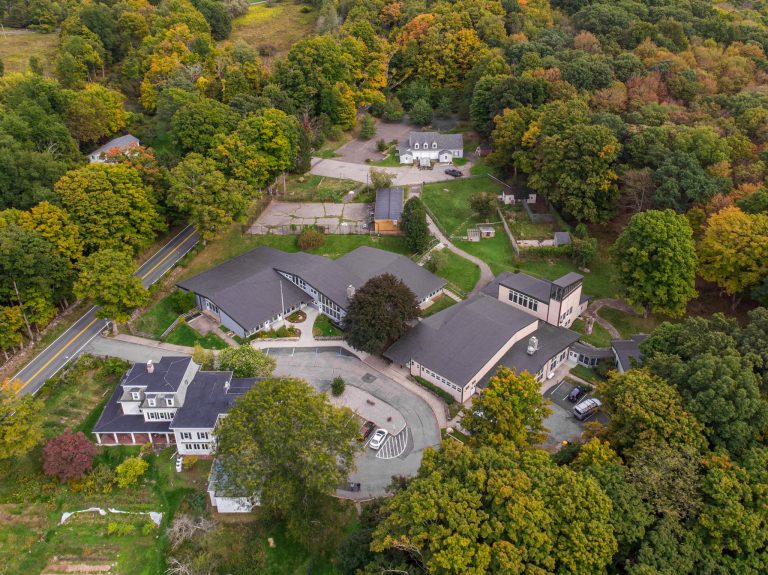
The museum is exhibiting Ali Banisadr: The Alchemist, which displays Banisadr’s works from as early as 2006 to sculptures made in 2025 for this exhibit. Not only is the exhibition a debut for these sculptures, but it is Banisadr’s first museum survey, spanning twenty years of his practice.
“It was really gratifying for myself to see this show because you have everything in one place from all these different times, spanning 20 years,” says Banisadr. “It was really interesting to see how things evolved out of each other.”
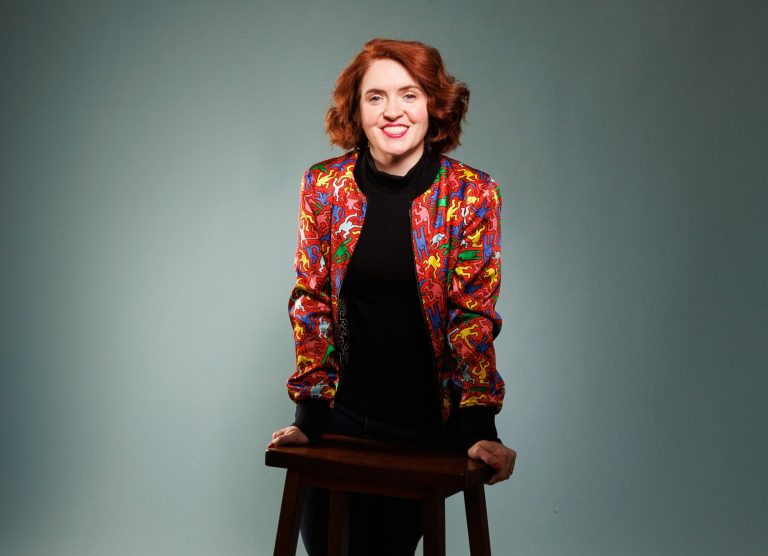
The museum’s director and chief curator, Michelle Yun Mapplethorpe, comments: “I was really struck and continue to be moved by the intensity and thoughtfulness of his paintings. They’re so dynamic and they’re so deep and all-encompassing that it’s really a pleasure to get lost in them.”
Deriving Answers From Chaoses Past And Present
Born in Tehran, Iran in 1976, Ali Banisadr grew up during both the Iranian revolution and Iran-Iraq war. Some of his first memories were centered around chaos.
“From when I was born to when I left Iran at the age of 12, everything was sort of surreal,” recalls Banisadr.
Art defined these traumatic experiences, and assumed the role of both a respite and attempt to understand the disarray surrounding him. As air raid sirens rang through radios and televisions, Banisadr’s family and neighbors made their way to the basement, where one of his neighbors kept her art studio. Despite any fear coursing through the moment, having tools of creation laid out before him allowed Banisadr to make worlds separate from the one above ground.
“You create these worlds and you kind of have control over that world,” says Banisadr. “It makes you feel grounded in some ways.”
Regardless of the medium, Banisadr’s works are surrealist odysseys, both searching for and deriving answers from chaoses past and present. He describes his work as “encyclopedic,” as it is layered with influences from art history – including Hieronymus Bosch and Francisco Goya – to celebrated poems such as “The Epic of Gilgamesh,” Dante’s Inferno, Yeats’s “The Second Coming.”
“You can constantly go back to this well of inspiration and information [in his works],” says Mapplethorpe. “It’s a dialogue with other artists, or other movements, or other time periods.”
His work provides homes – or hells – for casts of characters both medieval and futuristic, settings familiar and unknown, storylines tragic and hopeful, current and historic.
“I’ve always looked for these external understandings to bring back into my work, like reading about mythology or religion or psychology or magic,” he says.
Ali Banisadr and the Elusiveness of Memory
These external references are emphatically evident in his paintings, which are rife with homages to artistic, literary, and textbook history. His sculptures, meanwhile, are shaped as antennae-like figures, as if they are physically tuning into and picking up stories, emotions and experiences from the past.
“Since I started making drawings as a kid, until now, there’s always this thread of being able to tap into your subconscious, your collective memory.” Says Banisadr. “It’s not just me, but it’s out there somewhere.”
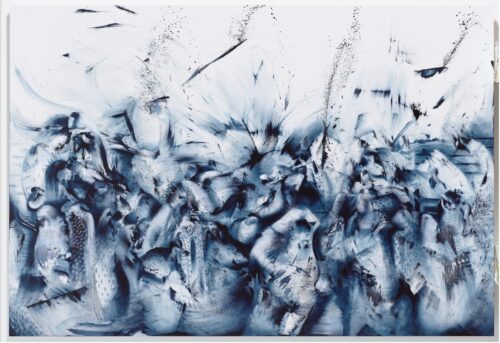
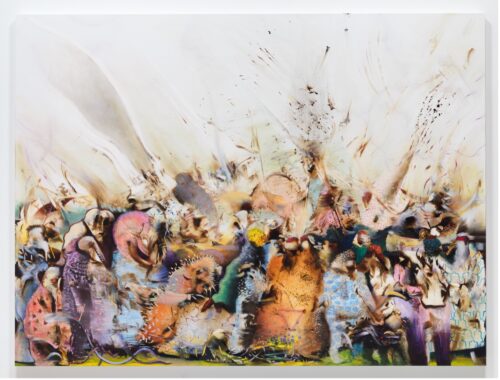
Banisadr’s paintings are characterized by their dramatic brushstrokes, inducing a sensation of movement, in turn replicating the elusiveness of memory and, in the artist’s view, how it travels from generation to generation.
One of Banisadr’s works, “Caravan,” made during the COVID-19 pandemic, pays homage to Pieter Bruegel the Elder’s, “The Triumph of Death,” which was made in 1562 during a plague. In the bottom right corner of Banisadr’s homage, a person’s leg appears to be trapped in a wheel, a symbol of time’s eerie movement.
Although Banisadr explains that there is a kind of magical – if not terrifying – feeling that occurs when we think of the experiences we face currently mirroring those of people from centuries ago.
“We’re the same people,” he says. “Maybe it’s changed its name, maybe it’s changed its costume, but [our experiences] are still the same recurring thing.”
In this vein, the scenes depicted in Ali Banisadr’s works can be seen as omens – but whether they are hopeful or terrifying, remains unknown.
You May Also Enjoy
- More Than a Dozen Upcoming Jazz Concerts in Westchester
- Caramoor’s 80th Season is for Dabblers and Devotees Alike
- 2025 Film Festivals in Westchester
- Here’s Where to Contact Congress to Keep Museums and Libraries Funded
Photos (top to bottom): These fragments I have shored against my ruins, 2023 (photo credit: Genevieve Hanson); Trust in the Future, 2017 (photo credit: Jeffrey Sturges); The Game of Taming, 2017 (photo credit: Diego Flores) // all copyright Ali Banisadr, courtesy of Katonah Museum of Art