The Guerrilla Girls Shake Up Westchester
A report card from 1986 told a scathing story. The grades were abysmal, and the comments even worse: “lacks initiative,” “delinquent,” “underachiever,” “failing.”
But these marks weren’t for students. They were aimed at some of New York City’s most influential galleries — Mary Boone, Leo Castelli, Allan Frumkin, Pace, and others — based on how many women artists they represented. In many cases, the scores were zeros and ones.
The report card, created by the Guerrilla Girls, was both protest and artwork — a clever, biting critique of gender inequality in the art world.
Forty years later, that same report card greets visitors at the start of Food for Thought, an exhibition at the Neuberger Museum of Art celebrating the 40th anniversary of this anonymous collective of female artists, on view through August 2.
The report card hangs alongside another 1986 piece that asks a blunt question in bold black-and-white: “How many women had one-person exhibitions at NYC museums last year?” Among the Guggenheim, Metropolitan, Modern and Whitney, only one — the Modern — had a number higher than zero.
Together, these posters anchor a group of ten early works from 1985 to 1990. Across the gallery, nine more recent works, created between 2020 and 2025, show how the Guerrilla Girls’ style has changed, while their message feels just as urgent.
Art as Intervention
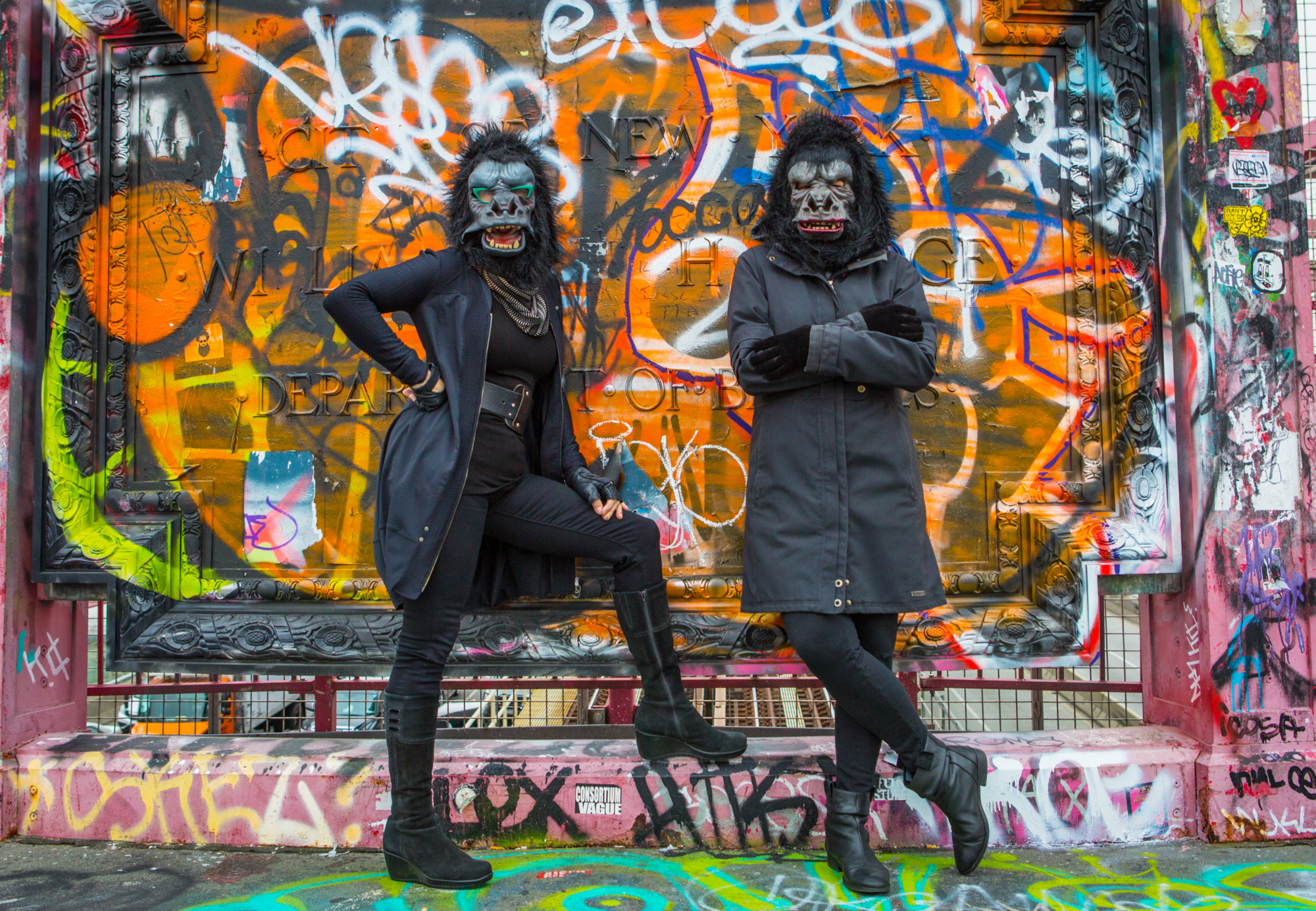
The Guerrilla Girls take their name from guerrilla warfare — something unexpected, bold, and hard to ignore. To preserve their anonymity, members wear gorilla masks in public, a choice sparked by an early media misspelling that they embraced. They also adopt the names of notable women artists and writers — Frida Kahlo, Gertrude Stein and Zora Neale Hurston among them — shifting the focus away from individuals and onto the message.
“When we think about guerrilla warfare, we think about hit-and-run tactics,” says Rem Ribeiro, curatorial assistant at the Neuberger and lead installer of the exhibition. “That’s exactly how they operated. They’d go out in the middle of the night with hundreds of printed lithographs and put them up like graffiti artists in various high-traffic spots across the city — on walls, bridges, sides of buildings — so commuters would see them everywhere the next day.”
Their posters paired sharp statistics with clever, sometimes sardonic phrases, calling attention to what museums were showing — and what they weren’t. Early works leaned on quick, bold graphics and a mostly monochrome palette, designed to be clear and impossible to miss.
They also embraced a popular 1980s strategy known as culture jamming — which, Ribeiro explains, “relies on satire, exaggeration or irony to expose underlying messages and question what we’re being sold.”
“Unless you’re in the art world, you don’t always think about why certain works are collected or why some artists are elevated,” Ribeiro explains. “The Guerrilla Girls wanted to put those questions — and answers — out there, but with humor.”
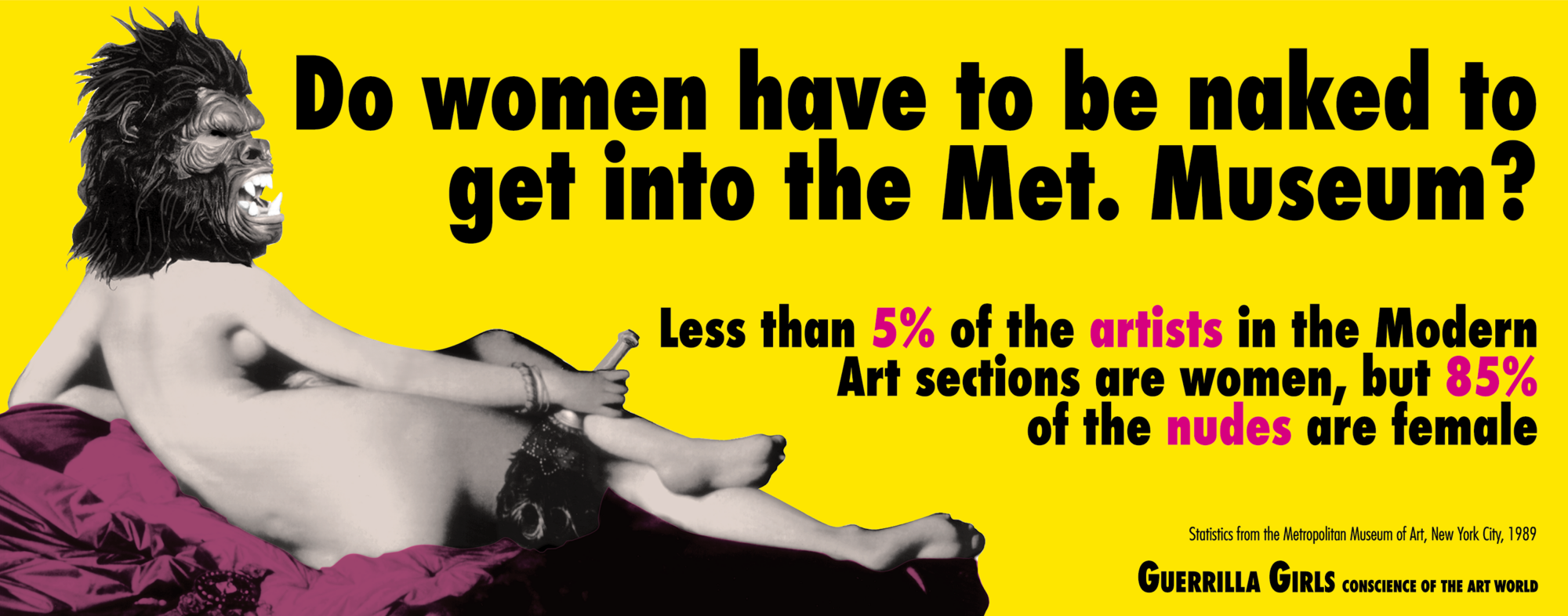
One famous piece, created in 1989 and commissioned by the Public Art Fund, was originally rejected as a billboard for “lacking clarity.” Titled Do Women Have to Be Naked to Get into the Met Museum?, it points to an imbalance: less than 5% of artists in the Met are women, but 85% of the women depicted are nudes. Undeterred, the Guerrilla Girls adapted it for city buses.
The Changing (and Not So Changing) Landscape
Four decades later, the group’s approach has evolved with the media landscape. Just steps from the early works displayed in the exhibitions, visitors encounter colorful prints from the past five years. While their signature punchy style is still there, the newer works use bright colors and bold imagery to stand out in today’s fast-moving visual culture.
Ribeiro notes that the group often circles back to its earlier ideas. One monochrome piece, The Code of Conduct, riffs on the Ten Commandments with satirical lines like, “Thou shalt not give more than three retrospectives to an artist whose dealer is the brother of the chief curator.”
In contrast, the 2024 Guerrilla Girls Manifesta uses color and direct language, calling on museums to disclose representation and confront systemic inequities. As Ribeiro explains, while the earlier works played with tradition and familiar imagery, the newer pieces take on the tone of rule-makers themselves — still funny, but more direct, and harder to ignore.
Food for Thought
If the visuals have shifted, the group’s ideas are just as layered. Many of the works in Food for Thought play with commercial culture, using pastries, apple pie and even Korean gochujang alongside sharp wordplay.
“Food is a way to explore culture, consumerism and power,” Ribeiro says, pointing to familiar phrases: “Chew on this. Let that settle in your stomach. Take a moment to digest it. Are you satisfied? Are you hungry for knowledge?”
Some early works referenced “white bread,” a shorthand for cookie-cutter middle-class culture, while others used phrases like “getting a piece of the pie” to think about who gets included and who doesn’t. That idea carries into more recent works that use pie charts to visualize inequality, making a familiar graphic harder to ignore.
“You need to see all parts of the whole to understand why things are the way they are,” says Ribeiro. A recent piece shows a large pastry representing the 400,000 graphic works in the MK&G Hamburg, while a tiny crumb represents the museum’s 1.5% works by women.
“With many of these pieces, they’re using different kinds of wordplay,” Ribeiro adds. “Art is a consumer product — whether it’s being purchased or displayed, it’s being consumed. So they draw on food language in a very literal way, but also in a more abstract sense.”
Forty years after that first report card, the Guerrilla Girls are still asking the same questions, just in louder colors and sharper terms. While the numbers may have shifted, their work makes one thing clear: there’s still more to be done. There may be more on the table, but it’s still not enough.
You May Also Enjoy
- ArtsNews Guide: 2026 Spring Exhibitions in Westchester
- ‘Modern Women / Modern Vision’ Surveys Work by Landmark Photographers
- Hidden Painting Discovered at Caramoor Leaves Some Questions Unanswered
- Caramoor’s Summer Season is Designed for Discovery
Photos (top to bottom): Guerrilla Girls (2016) (photo credit: Katie Booth); Guerrilla Girls, Do Women Have to Be Naked to Get Into The Met. Museum? 1989 (Copyright © Guerrilla Girls, courtesy guerrillagirls.com)
About Laura Schiller
Laura Schiller is an arts journalist based in lower Westchester. She contributes frequently to The Rye Record, The Rivertowns Dispatch, and The Recorder News, among other publications.