‘Modern Women / Modern Vision’ Surveys Work by Landmark Photographers
Modern Women / Modern Vision: Photographs from the Bank of America Collection, now on view at the Hudson River Museum through May 10, surveys work by generations of woman photographers. The chronologically organized exhibition, which features the likes of Berenice Abbott, Dorothea Lange, Carrie Mae Weems and more, showcases 97 artist-authorized prints from Bank of America’s collection. The works are displayed in a distinctive configuration under the supervision of Chair of the Curatorial Department Laura Vookles and Assistant Curator Shilpi Chandra.
An Emerging Artform
The exhibition is divided into six sections, beginning its survey in 1905, about 70 years after the advent of photography.
“[At this] moment in photography, there is a lot of emphasis on what the photographic artform is going to be,” says Vookles. The Pictorialism movement, most active until around 1915, aimed for photography to have the same level of artistic credibility as traditional mediums like sculpture and painting. Until then, the medium had been mostly considered a documentation tool.
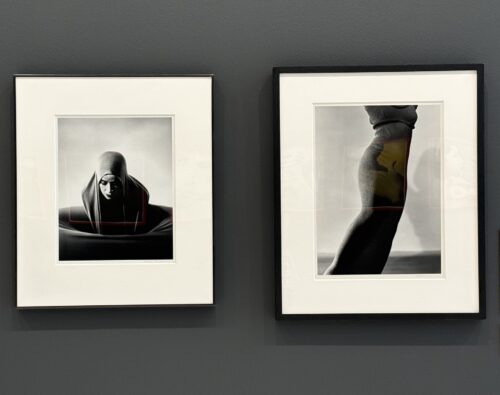
In “Modernist Innovators,” the first of Modern Women’s six sections, Barbara Morgan’s portrait of dancer-choreographer Martha Graham, Lamentation, greets exhibition-goers. Morgan photographed Graham numerous times throughout her career, intending to capture the dancer’s gestures and movement. In the portrait, Graham is draped in billowing fabric from her dance routine, her head hovering above a pool of cloth.
Chandra points out that the depiction of the dancer departs from traditional Biblical and art historical subjects, and that the image is carefully considered: “This is how this person chooses to portray herself, right?” Vookles adds: “[Graham] is very much forward and meeting the audience.”
Changes and Continuities Over Time
Differences and similarities are teased out between and across Modern Women’s six sections. Changes in available technology and the growing acceptance of color photography are reflected in the various types of prints on display. The show’s smallest prints are traditional darkroom prints seen in sections “Modernist Innovators” and “Documentary Photography and the New Deal.”
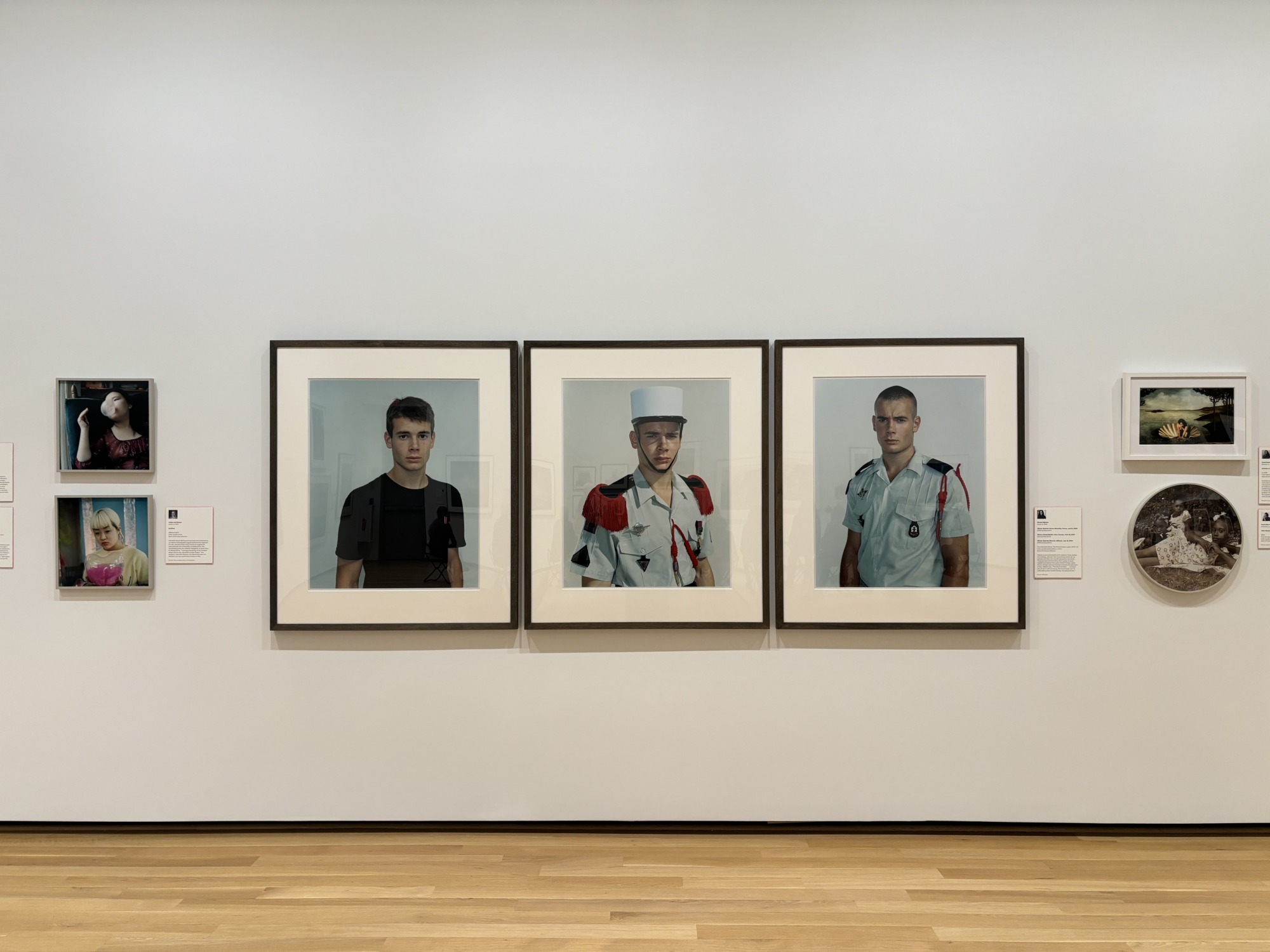
Large-scale work is most prevalent in the three contemporary sections: “Modern Masters,” “Exploring the Environment,” and “Global Contemporary Lens.” Rineke Dijkstra’s towering color portraits of young legionnaire Olivier Silva are hard to miss in the final gallery. The three images, part of Dijkstra’s series that examines Silva’s physical and mental changes over the course of three years, is a departure from Morgan’s black-and-white portrait of Graham. However, both share intentionally constructed depictions of their photographic subjects.
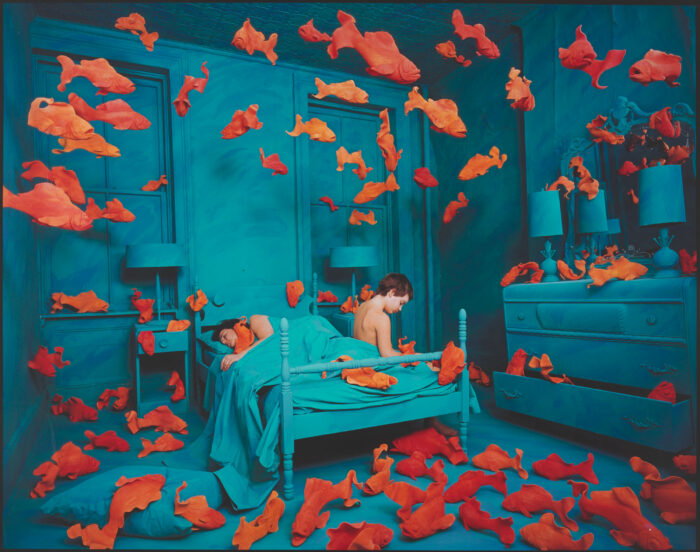
Sandy Skoglund, whose photograph Revenge of the Goldfish is included in the show’s “Modern Masters” section, identifies with photographers who create work “meant to be photographed.” Depicting a young boy awake in a colorful dreamworld where fish swim in the air, Revenge exemplifies the conceptual worlds Skoglund builds and photographs.
Though made decades after the Pictorialist movement quieted down, Revenge is connected to that lineage. Skoglund found herself “totally bored by black-and-white photography,” explaining “color was important, because I really wanted to make photography compete with painting.”
Skoglund first picked up a camera to document the conceptual installations she began creating in the ‘60s and ‘70s: “It’s not as if I’m just running around trying to do things in order to photograph them,” she clarifies. This approach differs from the numerous works on display that were constructed specifically for the camera.
Looking Back at the Canon
Modern Women raises questions of what grouping a show based on gender allows and how gender intersects with the creation of a photograph.
Vookles and Chandra view the exhibition as a way of spotlighting artists that may have been overshadowed in their lifetimes. “A lot of these women were part of important photographic movements of their time… but they themselves were not given as much importance or as much visibility as their male colleagues,” says Chandra.
“For once, no one can write a review of the show and say, ‘well, next to Stieglitz, blah, blah, blah, blah’ because Stieglitz is not in the show,” jokes Vookles.
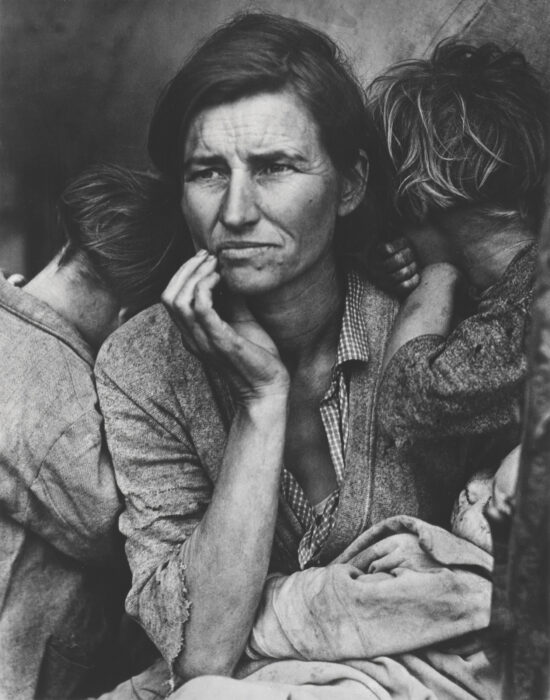
Many of the artists in Modern Women interrogate and respond to canonical work by male artists. Dorothea Lange’s iconic Migrant Mother, a Great Depression era portrait of an impoverished field worker and her children, alludes to Michelangelo’s Pieta, which depicts crucified Jesus in Mother Mary’s arms.
In the “Global Contemporary Lens” section, Carol Espindola’s Atlantis riffs on Botticelli’s Birth of Venus to examine beauty and gender expectations. Espindola’s photograph shares the wall with Carrie Mae Weems’ After Manet. In Weems’ take on Le Déjeuner sur l’herbe, Manet’s naked white women and clothed male companions are replaced by four young Black women, three of whom return the camera’s gaze with a steady confidence.
The Photographic Gaze
Vookles suggests that Lisette Model’s Woman at Coney Island, New York, the first photograph in the show, depicts a non-traditional “bathing beauty” that departs from the “male gaze”: “I think you just have a very different sense of who’s looking at who and what the relationship going on between the photographer and the person being photographed is, than if it was a man approaching a woman… To me, you have to consider not just what is the photographer deciding to photograph, but what kind of relationship is she setting up with the person in the photograph?”
Though Skoglund is not against grouping a show on the basis of gender, she is not certain gendered work can be easily discernable: “I think that you could look at this exhibition without the names of the people…let’s say you just landed here from Mars, and you went to this show and looked at it. Would you feel as though these are images that are made by women? I don’t think so, actually.”
A show this expansive reveals there is no singular way artists work with photography or think about the medium. Modern Women / Modern Vision gives exhibition-goers a space to engage with enduring photographs and the questions, contradictions and through-lines that follow them.
The exhibition is on view at the Hudson River Museum until May 10. Docent-led Highlights Tours are held on Friday afternoons. In addition, events in conjunction with the exhibition include a curator tour on March 7 and a panel discussion on March 15.
You May Also Enjoy
- Hidden Painting Discovered at Caramoor Leaves Some Questions Unanswered
- Mamaroneck Artists Guild Is Thinking Big at the Rye Arts Center
- Katonah Museum and Pocantico Center Team Up for Joint Exhibition
- Arts Awards Highlight Cultural Work Rooted in Community
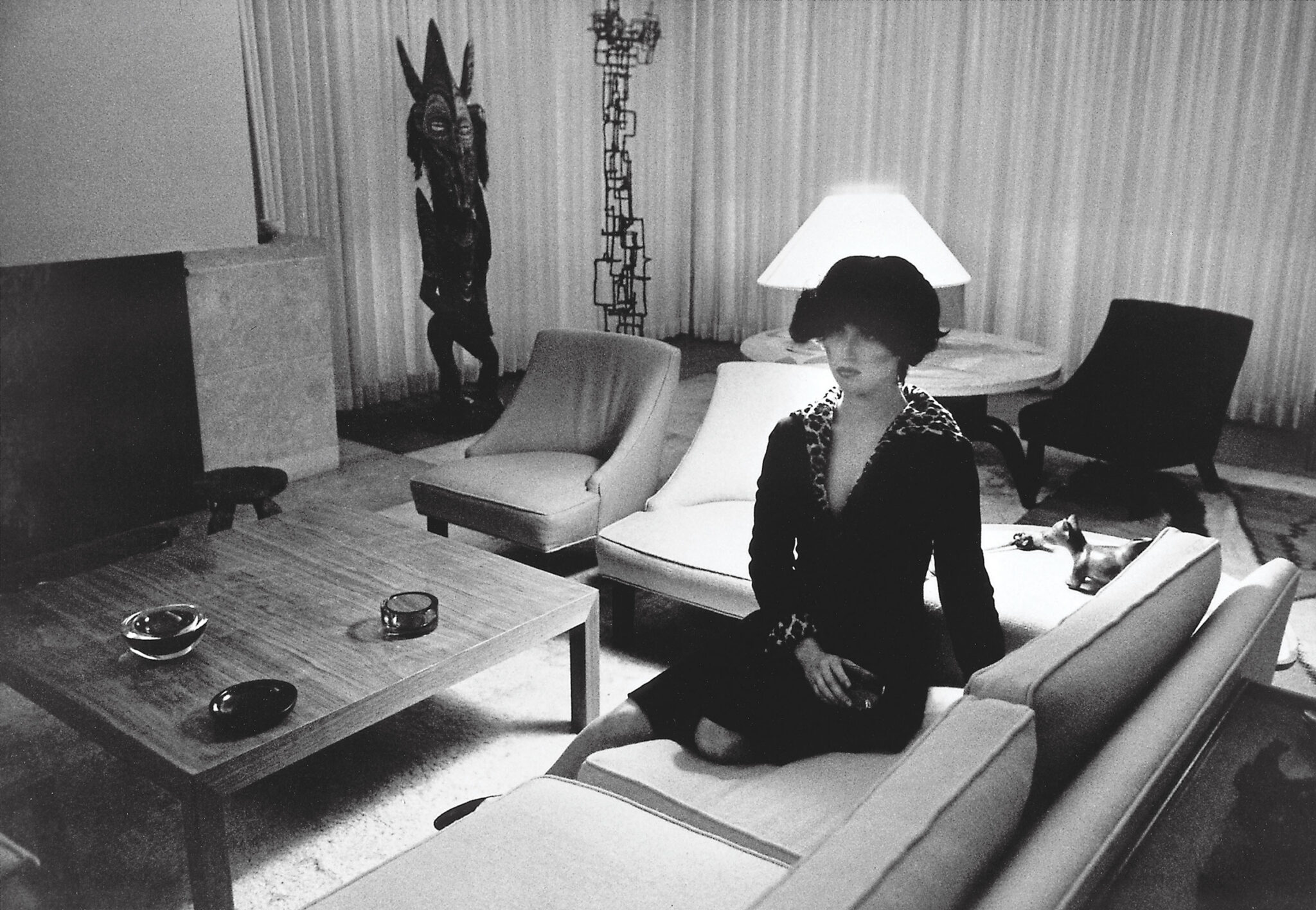
Photos (top to bottom): Sandy Skoglund (American, b. 1946). Revenge of the Goldfish, 1981. Cibachrome print (edition 7 of 30). Bank of America Collection. © Sandy Skoglund; Works by Barbara Morgan on view in Hudson River Museum (photo by Mia Castellano); works by Rineke Dijkstra on view in Hudson River Museum (photo by Mia Castellano); Dorothea Lange, Migrant Mother, Nipomo, California, 1936. Printed 1967. Gelatin silver print. Bank of America Collection; Cindy Sherman, Untitled Film Still #50, 1979 (printed 1989). Gelatin silver print. Bank of America Collection. © Cindy Sherman.
About Mia Castellano
Mia Castellano is ArtsWestchester’s Digital Content Manager. She writes “What’s Westchester Watching?,” a monthly movie guide featuring new releases and special screenings, for ArtsNews. Mia holds a Bachelor’s degree concentrated in filmmaking and photography from Sarah Lawrence College.