Shadows Come to Light: ‘The World of Ugo Mochi’ in New Rochelle
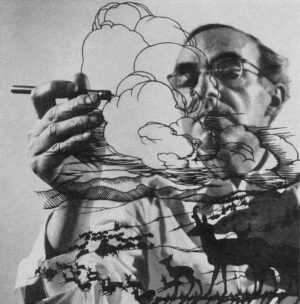
Most people pass through New Rochelle City Hall without noticing a striking mural by renowned artist and longtime resident Ugo Mochi. Suspended from the ceiling, the 10-foot black cardboard cutout, Landing of the Huguenots, memorializes the city’s founding by French Protestant refugees.
Although Mochi took artistic license with history (Huguenots first landed in New York City and then traveled over land to New Rochelle), the work conveys a symbolic origin story with themes of migration, resilience and community beginnings. Figures emerge like shadows from the past and, despite the lack of color or facial detail, the scene suggests a strong sense of movement, drama and shared human journey—hallmarks of Mochi’s distinctive style. An immigrant from Italy who built a new life in the U.S., Mochi connected personally to the idea of starting over in the new place. Appreciating the sentiment conveyed by the artwork, the New Rochelle community raised funds to purchase the panel for the city in 1977, the year of Mochi’s death.
Nearly 50 years later, the New Rochelle Council on the Arts (NRCA) presents an exhibition, The World of Ugo Mochi, that celebrates cut-paper artworks by “The Poet of Shadows,” spanning periods of his career as illustrator, sculptor and designer. The works are loaned from the Mochi family’s private collection.
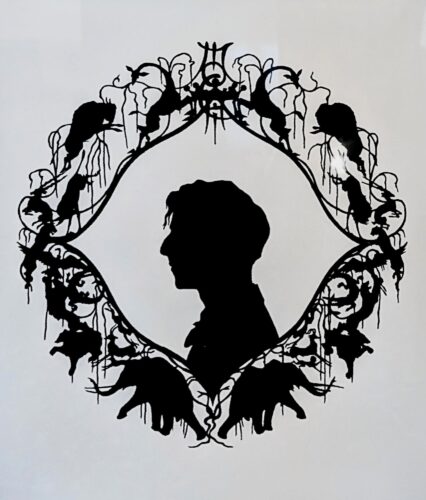
Theresa Kump Leghorn, NRCA president, says Mochi “wanted to put his work in context of who he was.” Self-Portrait exhibits Mochi’s mastery of cutouts while revealing identity through a love of animals: creatures frame his profile as decorative elements. At the same time, the artist’s signature is part of the same cutout, camouflaged within the design.
Animal subjects dominate the retrospective, appearing in book illustration, standalone works, and panels that replicate commissions for the American Museum of Natural History. Kump Leghorn notes that “animals captured Mochi’s imagination.” Mochi pursued accuracy by researching subjects and placing them in realistic habitats rendered with meticulous attention throughout the landscape. Deer in the Woods, for example, pairs anatomically precise deer with a dense lattice of trunks, branches and undergrowth; layered silhouettes create depth – like relief carving in paper – embedding the animals convincingly in their environment. Each blade of grass and overlapping twig is cut with surgical crispness.
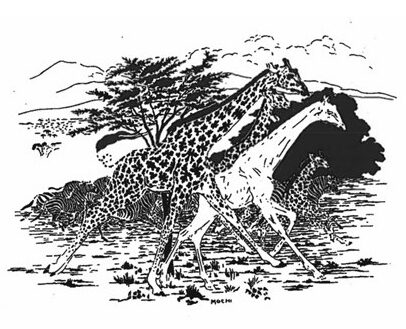
This blend of intricacy and dynamism continues across the show: in Leafy and Albino Giraffes and Zebras, animals gallop through grassland; in …and Suddenly a Storm Came Up, alarmed horsemen ride through rain and lightning. The latter also reflects Mochi’s sculptoral training. As Kump Leghorn observed, he had a “three-dimensional way of looking at things,” producing “forceful, almost abstract” compositions that still tell a story.
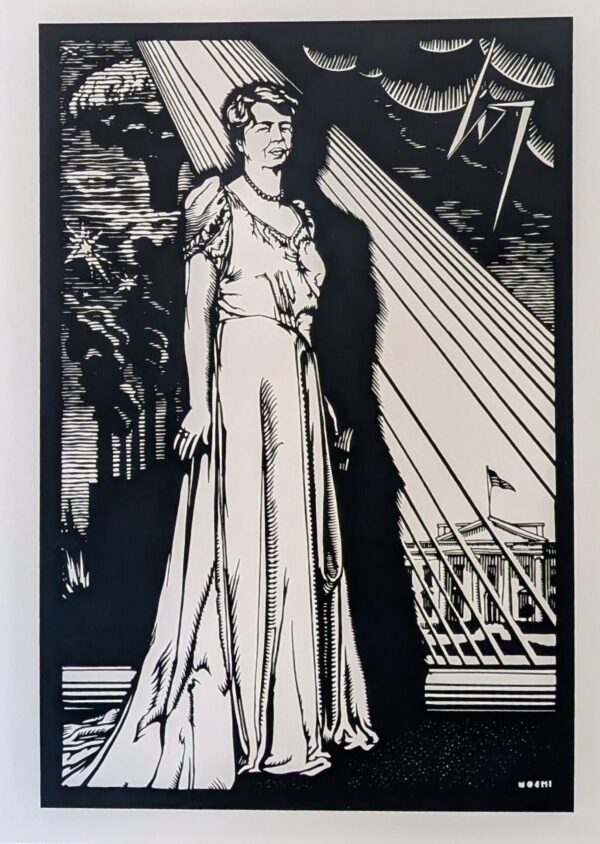
One gallery wall features The First Ladies of the White House (1943), commissioned by World Book Encyclopedia. The exhibition includes six prints on plastic panels — the original 32 of which are held by the Smithsonian Institution’s National Museum of American History in Washington, D.C. The first ladies, including Martha Washington and Eleanor Roosevelt, are portrayed in inaugural gowns set against a White House backdrop.
Mochi developed his elaborate technique early. The process began with a pencil sketch, which he placed on a panel or on glass covered with a single sheet of black paper that is destined to become the finished work. Using a sharp lithographer’s knife, he cut through the sketch into the black paper, treating the drawing as a guide rather than a strict template. After an initial rough cut, he refined and deepened details—often with a magnifying glass—until the final image emerged as one continuous piece that could be lifted and transferred to another background.
In an autobiographical documentary on his website, Mochi said, “I draw in outline form… my aim is to give life, movement and perspective to the figure.” Visitors can examine this intent at the NRCA Rotunda Gallery through June 30 during City Hall business hours. A reception will take place on May 12.
You May Also Enjoy
- ArtsNews Guide: 2026 Jazz Events in Westchester
- Spring Arts & Crafts Festivals 2026
- Caramoor’s Summer Season is Designed for Discovery
- The Guerrilla Girls Shake Up Westchester
Images: All artworks courtesy of New Rochelle Council on the Arts.
About Yana Rolnik
Yana Rolnik is a freelance art historian and full-time Director of Software Engineering at Confluence Technologies. She has a Bachelors in Computer Science, Masters in Art History, and is pursuing Masters in Entrepreneurship in the Arts.