A Rare ‘Window’ Into Marc Chagall and His Process

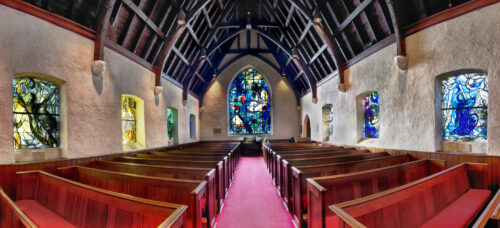
The Union Church of Pocantico Hills may seem unassuming, but it is residence to some of the most significant works of modern art in the county in the form of stained-glass masterpieces: the last commissioned work by Henri Matisse, and the nine windows by Marc Chagall.
The windows, commissioned by the Rockefeller family, depict parables of Old and New Testaments of the Bible while also telling stories of the Rockefellers. For instance, Matisse’s Rose Window was commissioned as a memorial window to Abbie Aldrich Rockefeller, who was one of the co-founders of the Museum of Modern Art. In a similar vein, a large nave window by Chagall depicting the story of The Good Samaritan was commissioned in the early 1960s to commemorate John D. Rockefeller, Jr.

A Rare Look at Chagall’s Process
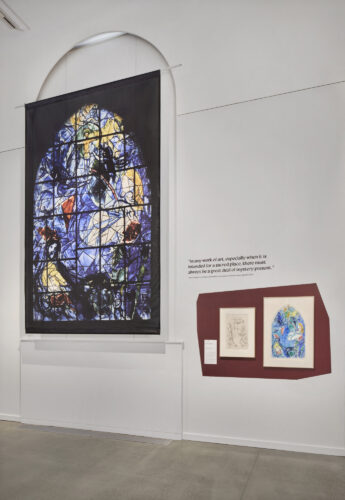
While Chagall rarely shared his sketches, David Rockefeller was able to acquire them in 1975 for the Rockefeller Archive Center. Now, in celebration of its 50th Anniversary, the Archive Center has collaborated with the Rockefeller Brothers Fund to present an exhibition, Sketching Light: Chagall’s Windows for Union Church, at Pocantico Center in Tarrytown, on view until May 17 in its The David Rockefeller Creative Arts Center.
Katrina London, who curated the show with Michele Hiltzik Beckerman, says that “Chagall loved his work to be seen in public spaces,” and it was one of the stipulations for the sale of his sketches that they would be displayed together. As such, visitors to the Pocantico Center’s exhibition can observe the creative process of the celebrated artist through all 27 preparatory sketches for the Union Church’s nine windows, along with supporting materials and other art objects by Chagall.
Chagall, who was born in 1887 in Belarus (then part of Russian Empire) and later moved to France, developed his distinctive style relatively early. Even though he absorbed the styles of Fauvism and Cubism movements while living in St. Petersburgh and Paris, he blended these stylistic methods with folk themes of his childhood’s Jewish Shtetl. He applied this “folkish” style through visual symbolism of recurring motifs in his biblical artworks, including these windows. The vibrant colors, as well as the simplified, almost cartoonish, outlines of depicted subjects, underline the emotional expressiveness of the portrayed characters.
Chagall and Biblical Stories
Though Chagall began designing stained-glass windows when he was nearly 70, he embraced the medium with youthful enthusiasm, experimenting with techniques and completing many commissions for various institutions across the world. Some of those experimentations can be traced in the preparatory Color Studies for Three Windows: 6-8 and Color Studies for Three Windows: 1-4, which illustrate that by making the two windows closest to The Good Samaritan (nave window)darker, and gradually increasing the light for the rest of the windows, the nave window would not overpower the church. London explains that Chagall “starts to use pieces of fabric, metallic paper, washes and paint to see how colors and the light would be seen” in the church.
While sketches for The Good Samaritan, in both color and in black ink, take center stage, other works provide illumination into Chagall’s process. Jeremia, which portrays an introspective prophet, “captures a combination of sadness with hope,” according to London.
Even though Chagall was inspired by biblical stories, London says that it was not always easy for him to reconcile his Jewish faith with commissions that involved depictions from the New Testament. She explains that this was probably the reason his works are not a straightforward representation of the religious parables, adding that the artist “wanted there to be mystery; he doesn’t want to be obvious, doesn’t want to reveal [his vision.]” In Seek and Ye Shall Find, which was done in memory of Michael Rockefeller, who died young during ethnological expedition, Chagall illustrates the recurring subject of Crucifixion which, according to curators, might have been interpreted by the artist “to represent the suffering of Jewish people.”
Completed Works Can Be Viewed at Union Church
Director of Communications, Sarah Edkins, points out that Sketching Light “stands on its own merit” and allows guests to “observe preparatory works going from abstract composition to elaborate drawing.” That said, guests who want to supplement their museum visit are also encouraged to visit the Union Church to see the completed windows on a tour led by Historic Hudson Valley. Union Church is open on select Saturdays: Self-paced tours of the church windows will be available March 15 and April 19, from 10am-3:30pm. Sketching Light: Chagall’s Windows for Union Church runs through May 17, and is open Thursdays through Saturdays from 11am-3pm.
You May Also Enjoy
- Irvington Theater Looks to First Summer Season
- 15+ Black History Month Events in Westchester
- Picture House’s Senior Cinema Program Evolves With Free Yoga
- Westchester Celebrates Women’s History Month 2025
- Oscar-Nominated ‘Sing Sing’ Spotlights Rehabilitation Through the Arts
Photos: Marc Chagall, Studies for three of the eight side windows for Union Church [detail], © 2024 Artists Rights Society (ARS), New York / ADAGP, Paris. Collection of the Rockefeller Archive Center. Photo by Mick Hales; Sketching Light installation photos (photo credit: John Muggenborg, courtesy of Pocantico Center); Stained glass windows by Marc Chagall at Union Church (photo credit: Jaime Martorano for Historic Hudson Valley)
Check back with ArtsNews regularly for more updates, and follow us on Facebook and Instagram for more arts events and cultural happenings!
About Yana Rolnik
Yana Rolnik is a freelance art historian and full-time Director of Software Engineering at Confluence Technologies. She has a Bachelors in Computer Science, Masters in Art History, and is pursuing Masters in Entrepreneurship in the Arts.