FACETS – A Katonah Museum Artists’ Association Exhibition at Yellow Studio

Through the lens of female artists, Yellow Studio’s current exhibition, FACETS, on view through February 9, investigates various ways of representing the complexity of self-identity. The annual show features works by 28 artists who are members of Katonah Museum Artists’ Association (KMAA), and is juried by Yellow Studio founder and KMAA member Tina Villaveces.
Villaveces, who came up with the theme for the show, explains that she wanted natural cohesion without a strict set of the parameters. This, she says, allowed her to “cast a wide net to capture identity across a variety of media” and bring together artists that “would appeal to a wide audience while not being afraid to be controversial.” In terms of subject matter and style, traditional representational works can be seen alongside abstract and conceptual artworks. The presented artworks include paintings, collages, photography, mixed media and film.
A conceptual mixed media sculpture by Marcy Freedman (My Sisters) covers a vintage female body form in a dress made with 40 photographs.
In both Sprinkles and More and Aqua, Cathy Skurman flips the art history narrative by using a traditional women’s domestic craft technique such as needlework and with it creates fully fledged framed abstract pieces that are typically associated with a highbrow male-dominated genre.
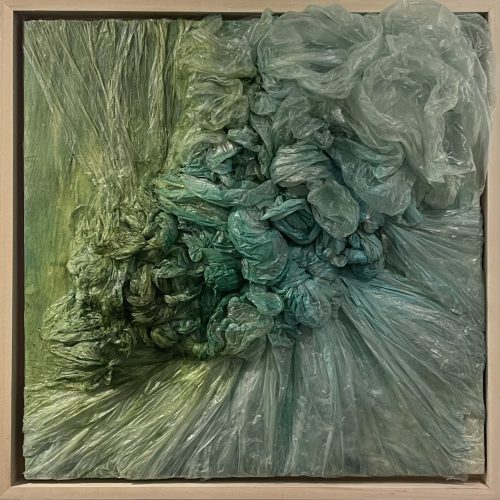
In three presented works, Rebecca Rivard utilizes uncommon materials to link nature with her self-identity. Her general body of work is inspired by nature and unpredictability or, as she explains, “letting go of the rigidity of the world.” For instance, in Unbound, painted plastic bags symbolize “the power of unleashing [herself]” from the constraints of ideals that are imposed by society. At the same time, discarded objects are given “new meaning, purpose and beauty.”
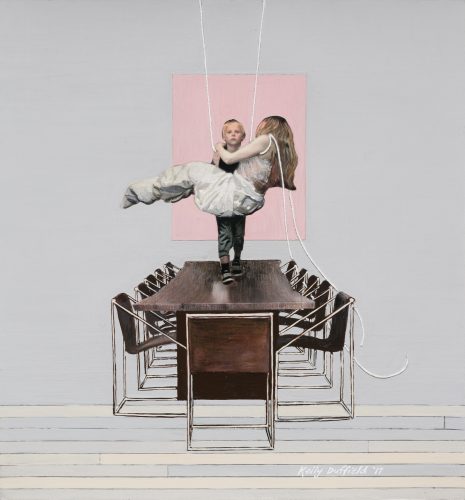
Direct references to identity can be seen in individual, but also in group portraits, very often of the family. While artists mention home life and family as a significant factor in a woman’s creative identity (e.g., Kelly Duffield’s whimsical collages, Brigid Kennedy’s domestic scenes and Randy Matusow’s “documentary” photography), these are not depictions of content women from the 1950s or idealized women of Renaissance. On the contrary, there is the intense gaze of Sherri Paul’s subject in Late Again, the self-confidence of Jill Parry’s Dominique, and the satirical self-representation in Dyan Rosenberg’s Making the Most of Your Close.
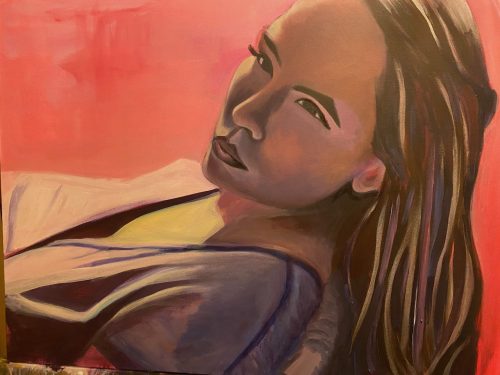
Similarly, the quiet power of Monique Ford’s model in Inside Out disputes the traditional notion of a woman’s portrait. Ford explains that she has deep connection to all women in her portrait series and aims to capture personality during a specific period of each subject’s life. Her primary tool is color. Influenced by post-impressionists such as Pierre Bonnard, Ford says that she “sees colors in everything” and adds distinct color hues where you least expect it – for instance in skin tone and hair color.
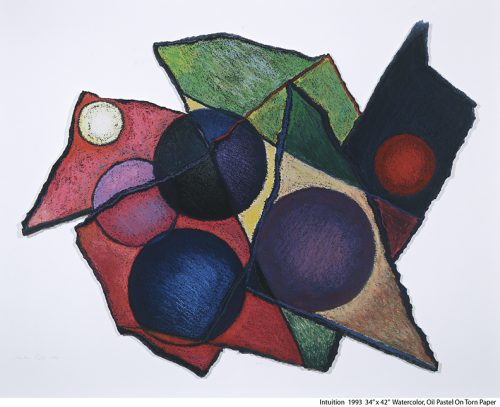
Another color master, Marlene Siff, pulls the viewer into the kaleidoscopic world of overlapping shapes in vivid colors that create an illusion of movement. Employing torn paper, Siff uses fragmentation as a reference to “our nonlinear lives” and attempts to “communicate a sense of harmony, balance, order and spirituality.”
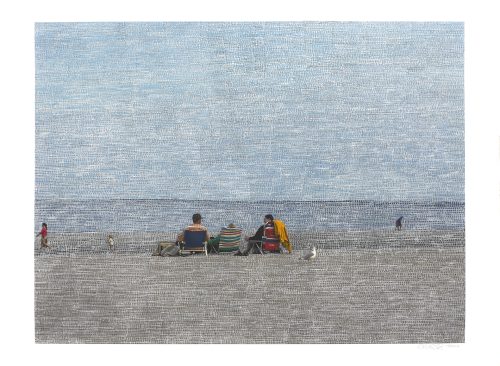
In both of Debra Graham’s works, the abstract Muted Dice and photo print Beachgoers, she first adds white ink and then black pencil squares that give her artworks three-dimensionality and a tactile quality that creates an effect of a mosaic or a textile. By doing this, Graham plays with the notion of “how the whole may or may not be greater than the sum of its parts.”
Photo credit: Facets Gallery Shot (photo credit: Kelly Schwark); Kelly Duffield, Untitled III (photo credit: Wes Magyar); Rebecca Rivard, Unbound (photo credit: Rebecca Rivard); Monique Ford, Inside Out (photo credit: Monique Ford); Marlene Siff, Intuition (photo credit: Tim Pyle); Debra Graham, Beachgoers (photo credit: Debra Graham).
About Yana Rolnik
Yana Rolnik is a freelance art historian and full-time Director of Software Engineering at Confluence Technologies. She has a Bachelors in Computer Science, Masters in Art History, and is pursuing Masters in Entrepreneurship in the Arts.